9mm vs .45 ACP: Which Handgun Caliber Is Right for You?
9mm vs 45 ACP compared on ballistics, recoil, capacity and cost, with FBI protocol test data, real 2026 ammo prices and clear advice on which to buy.
The 9mm vs 45 ACP argument has been running since before most of us were shooting, and it is still the first question a new handgun buyer asks after deciding to buy a handgun at all. The honest answer in 2026 is that both cartridges work, both meet the same performance standard with quality defensive ammunition, and the right choice is decided by the shooter and the pistol rather than by the number stamped on the barrel.
That said, 9mm vs 45 ACP is not a distinction without a difference: the two rounds differ in ways that matter to your training budget, your carry comfort, and how fast you can put a second shot where you want it.
Where the Two Cartridges Came From
The 9x19mm Parabellum was designed by Georg Luger and introduced in 1902. It fires a 0.355 inch bullet and is the most widely produced centerfire pistol cartridge on earth. The .45 ACP was designed by John Browning in the early 1900s for what became the Colt M1911, and fires a much fatter 0.452 inch bullet at considerably lower velocity. One was built around a small fast projectile, the other around a large slow one, and every practical difference in the 9mm vs 45 ACP comparison flows from that single design decision.
- 9mm: typical 115 grain loads leave a service length barrel around 1150 to 1200 feet per second for roughly 340 to 365 foot pounds of energy. 124 grain runs a little slower, 147 grain subsonic loads sit near 950 to 1000 feet per second.
- .45 ACP: the classic 230 grain load runs about 830 to 870 feet per second for roughly 350 to 400 foot pounds. Lighter 185 grain loads push past 1000 feet per second.
- Energy numbers in the 9mm vs 45 ACP comparison land surprisingly close. The difference is in how that energy is delivered: 9mm arrives fast and light, .45 ACP arrives slow and heavy.
9mm vs 45 ACP on Terminal Performance
The industry benchmark is the FBI protocol, which fires test rounds into calibrated ten percent ordnance gelatin through six barriers: bare gelatin, heavy clothing, steel, wallboard, plywood and automotive glass. The target window is 12 to 18 inches of penetration with reliable expansion. Modern jacketed hollow points in both calibers routinely meet that window. That is the crux of the 9mm vs 45 ACP question today: bullet design closed the gap that existed in the 1980s, when 9mm hollow points were far less reliable than they are now.
The FBI’s own 2014 review concluded that with current duty ammunition there was no meaningful difference in wounding effectiveness between 9mm, .40 S&W and .45 ACP, and the agency moved back to 9mm on the basis of shootability and capacity. The .45 does carry roughly thirty percent more momentum, which shows up as slightly better barrier penetration and a marginally wider permanent cavity, but not in a way that reliably changes outcomes. What changes outcomes is hits, and hits are a function of the shooter rather than of the 9mm vs 45 ACP label on the box.
If you want to go deeper, the load data and cartridge dimensional standards published by SAAMI are the reference the manufacturers themselves work to, and major makers such as Federal Premium publish barrier test results for their duty lines.
9mm vs 45 ACP on Recoil, Capacity and Shootability
This is where the practical differences live. A full size 9mm pistol such as a Glock 17 holds 17 rounds in the magazine; the same sized Glock 21 in .45 ACP holds 13. Compact models widen the gap further. Single stack 1911s in .45 typically hold 7 or 8. If magazine capacity matters to you, 9mm wins on the spec sheet in nearly every comparable platform.
Recoil is the part of the 9mm vs 45 ACP question that is more nuanced than “the .45 kicks harder.” The .45 ACP produces a heavier, slower push; 9mm produces a sharper, quicker snap with less total impulse. Many experienced shooters find a steel framed .45 pleasant, because the extra mass soaks up the push. Put the same cartridge in a light polymer compact and it becomes noticeably harder to control. For most shooters, split times and second shot accuracy are measurably better with 9mm, and that advantage grows the smaller the pistol gets.
- Grip circumference: .45 double stacks are physically thicker, which matters if you have small hands or you carry inside the waistband.
- Follow up speed: 9mm is generally faster for equal skill.
- Suppressed shooting: standard 230 grain .45 ACP is already subsonic, so it suppresses beautifully without special ammunition. 9mm needs 147 grain or heavier subsonic loads.
- Platform choice: far more pistols, holsters and factory loads exist for 9mm than for any other handgun cartridge.
9mm vs 45 ACP on Cost and Training Volume
Ammunition price is the part of the 9mm vs 45 ACP comparison most people underweight and then feel every month. In mid 2026, bulk 115 grain 9mm full metal jacket practice ammunition commonly sells around $0.17 to $0.25 per round, while 230 grain .45 ACP practice ammunition typically runs $0.28 to $0.40 per round. On a 500 round training month that is a difference of roughly $60 to $80. Over a year of serious practice it is the price of another pistol.
Skill is bought with repetitions, not with case diameter, which is what makes 9mm vs 45 ACP a budget question as much as a ballistics one. If the cheaper cartridge lets you shoot twice as much, the cheaper cartridge is very likely the better defensive choice for you. You can compare current pricing across both calibers in our ammunition category, and it is worth pricing your practice load and your carry load separately, because defensive hollow points cost several times more per round in either caliber.
Which One Should You Buy?
Strip the 9mm vs 45 ACP debate down to a purchasing decision and it comes out like this. Buy 9mm if you are a new shooter, if you want maximum capacity, if you plan to train in volume, if you are choosing a compact carry gun, or if you simply want the widest choice of pistols and holsters.
Buy .45 ACP if you love the 1911 or a full size steel platform, if you shoot it demonstrably well, if you plan to run a suppressor without buying special ammunition, or if you value the heavier push over the sharper snap. Neither answer is wrong. A .45 you shoot well beats a 9mm you flinch with, and the reverse is equally true.
Whichever way you go, spend your money in this order: a pistol that fits your hand, quality defensive ammunition that has been tested to the FBI protocol, a proper holster, and then as much range time as you can afford. If you are ready to compare pistols side by side, our handgun catalog lists both calibers with capacity and barrel length on every listing.
9mm vs 45 ACP: Frequently Asked Questions
Does .45 ACP have more stopping power than 9mm?
Not in any way that holds up to testing, which is why the 9mm vs 45 ACP argument no longer turns on stopping power. With modern expanding ammunition both cartridges land inside the same 12 to 18 inch penetration window, and law enforcement research has repeatedly found no statistically meaningful difference in effectiveness. Shot placement and the number of accurate hits dominate every other variable.
Is 9mm better for concealed carry?
For most people, yes. Comparable 9mm pistols are thinner, lighter, hold more rounds and are easier to shoot quickly. That is why 9mm has won the 9mm vs 45 ACP argument in the modern carry market. A slim single stack .45 remains a valid choice for shooters who prefer it and practice with it.
Can I shoot .45 ACP in a 9mm pistol?
No. They are entirely different cartridges with different case, bullet and chamber dimensions, and they are not interchangeable in any way. Always confirm the caliber marking on your barrel or slide and buy ammunition that matches it exactly.
Shop what you just read about
Ammunition, optics, parts and gear, shipped to all 50 states. Firearms transfer through your local dealer.
Browse the inventoryKeep reading
Ammo Prices in 2026: What to Buy Before Deer Season, What Can Wait for the Holiday Sales
Ammo costs more than it did a year ago. Several of the biggest US ammo brands raised prices in April…
Read more ›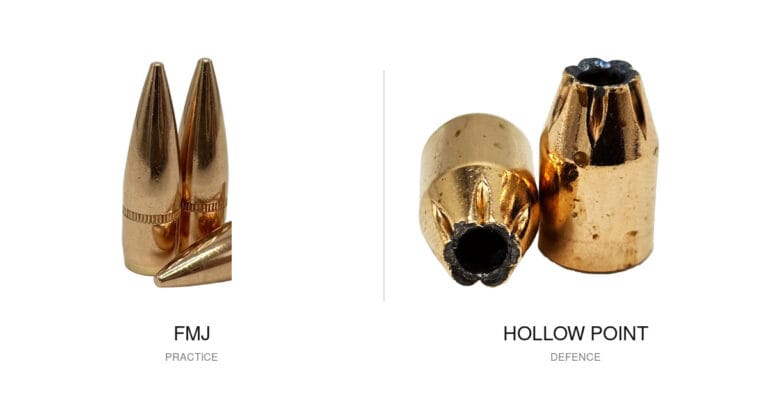
FMJ vs Hollow Point: Which Ammo Should You Actually Buy?
FMJ is for practice, hollow point is for defence. Here is what actually differs, why overpenetration is the argument that…
Read more ›
.223 vs 5.56: The Real Difference, and Which One Your Rifle Can Shoot
A rifle stamped 5.56 shoots both .223 and 5.56; a rifle stamped .223 should not shoot 5.56. Here is why,…
Read more ›